 |
|
|
|
|
|
|
 |
|
|||||
 |
 |
 |
 |
 |
 |
|
|
|
|
 |
|
|
 |
 |
|
 |
|
|
 |
|
|
 |
|
|
 |
|
|
 |
|
|

Armenians in Canada
After 1914
With the outbreak of World War I and the mass deportation and massacre
of the Armenians by the government of the Young Turks, the Armenians in
Canada could not even dream of going back home, but lived the torment
of locating lost relatives, if any had survived. Moreover, the Immigration
authorities in Canada adamantly opposed to grant per mission to the surviving
relatives to immigrate. A number of Canadian church leaders were able
to arouse sympathy among the public to support their effort. About six
months after the outbreak of the execution of the plans of deportations
and massacres by the Ottoman government, the Canadian Churchman, a publication
of the Church of England of Canada, now the Anglican Church, published
reports of the sufferings of the Armenian people. The editorial of the
same publication, in its October 14, 1915 issue stated:
"According to Lord Bryce the continuous and wholesale slaughter of
the Armenians is not the outcome of passion, but a careful plan for extirpating
Christianity all over Asia Minor and Armenia. The Christian population
is being deliberately exterminated with diabolical accompaniments, and
Lord Bryce calls attention to the obvious fact that the Allied Powers
cannot stop the massacres for which Germany must accept a full measure
of responsibility."
The Canadian Churchman was not alone in appealing to the Canadians to
come to the aid of the distraught Armenian remnants. The Presbyterian,
Methodist and Congregational churches, some of which already had missionaries
in the Ottoman Empire, also had a great role in the humanitarian efforts
that followed. Soon the Canadian National Association for Armenian Relief
was organized, whose campaign was supported by the Toronto Globe.
The efforts of the churches and media bore fruit. It is believed that
Canadians contributed $300,000 toward food, clothing and housing for the
refugee Armenians scattered in the countries of the Middle East. In 1922
an ecumenical organization by the name of the Armenian Relief Association
of Canada was formed under the patronage of the Governor General of Canada
and comprised many prominent Canadians and the famous Armenian rug merchant
Levon Babayan. The Association worked to secure the entry of one hundred
Armenian orphan boys from the orphanages 'in the Middle East, and settle
them on a farm. A countless number of orphans had already been gathered
from the regions of Asia Minor and the Middle East by the Near East Relief
Society in New York, the Armenian General Benevolent Union and others,
and placed in orphanages established by the same organizations in Greece,
Lebanon, Syria, Egypt and Palestine (at the time).
The task of the Armenian Relief Association of Canada to bring these orphans
was not an easy one, considering the tough immigration regulations at
the time. After persistent efforts, the Association was finally able to
secure the entry of fifty boys from Corfu into Quebec on June 29, 1923.
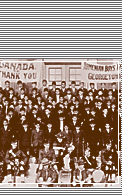
The orphans arrived at a farm that was later known as 'The Armenian Boys'
Home', near Georgetown, Ontario. The orphans, known as 'Georgetown Boys'
and still affectionately called so by the Armenian community, were trained
in all aspects of farming. A year later, on September 30, 1924, forty
more boys arrived in Halifax, and soon found their home on the same farm.
But here too they were to face new difficulties: the authorities attempted
to change their 'unpronounceable' Armenian names to 'simpler Canadian
names', but were met by resistance by the boys, who argued that they had
already lost everything in the world and only had their names as precious
reminders from their past.
To complete the initial wish of having one hundred orphans on Canadian
soil, a third group of eight boys and two girls arrived in Providence,
Rhode Island, on July 30, 1926 and were soon transported to Georgetown,
Ontario. One year later, and having proved the good job they had done,
the Association got permission to bring one hundred more orphans into
Canada, but internal disagreements, associated with the 'waning public
interest', did not help the execution of the plan. The Association sponsored
the entry of twenty-nine girls between the ages of sixteen and eighteen
in the years 1927-32, who 'were placed in domestic service 'in Toronto
homes for a period of two years.' These girls in time got married and
found their permanent homes either 'in the United States or Canada.
The boys' education on the farm was not comparable to that provided to
other children in rural Canada at the time. Like their Canadian counterparts,
the orphans had to tend to the farm and therefore were often absent from
the classroom, but they also had to work in the kitchen and the building.
Moreover, the teachers they had, the superintendents, did not have training
in teaching, neither could they allot their time only to teaching, since
they had other duties to attend to. One of the effective ways the boys
could keep their identity was the publication of the Ararat magazine,
that 'included original writings both in Armenian and English as well
as translations.
Gradually, after having possessed enough farming skills, some of the boys
were sent out to other farms in Ontario. In December 1927, the Farm Home
was sold and converted into Cedarvale Home for Girls and the Armenian
Relief Association's assets were transferred to the United Church of Canada.
Many of the boys were left almost without shelter. Some were lucky to
be taken 'in by farmers who also gave them a good education, but others,
less fortunate, were employed as cheap farm laborers and Missed the chance
of a good education. In time, most of these boys, young men by now, ventured
out into the cities and there also faced new difficulties arising from
their insufficient knowledge of English. About twenty-five of them joined
the army on the onset of World War II, others volunteered at various stages
and three lost their lives on the battlefield.
During the early 1920's, Canada allowed some thousand Armenians to immigrate.
Besides the Georgetown Boys, the majority were young women who had survived
the Genocide and like the orphans, had found refuge in various countries
of the Middle East. Marriages between these women and the widowed or eligible
men who were in Canada were arranged through intermediaries or marriage
brokers.
Between 1926 and 1955, a total of 704 Armenians are believed to have entered
Canada as immigrants. This relatively low figure reflects the policy of
the Immigration authorities, who classified Armenians as 'Asiatic'. '17he
Canadian government, in order to restrict the entry of undesirable elements
that could not assimilate easily in the Canadian society, categorized
settlers from northern and western Europe as Preferred Group, those from
central and eastern Europe as Non-Preferred Group and all the rest - including
all Jews, people from Italy, Greece, Bulgaria, Syria and Turkey - as Special
Permit Group. Armenians fell in the last category.
between 1931 and 1951 most of the Armenian immigrants were admitted into
Canada on humanitarian grounds. The admission of those between 1950 and
1951 may be attributed to the considerable relaxation of immigration regulations
on humanitarian grounds concerning Armenians, by Colin Gibson, the Minister
of Immigration at the time. The Armenian National Committee for Homeless
Armenians was established in 1947 in collaboration with Armenians in the
United States. The latter was formed in the aftermath of World War 11,
to help find refuge to the displaced Armenians living in European camps.
On April 3, 1948 the Canadian branch became independent, called the Canadian
Armenian Congress, and had representatives from the existing communities
in Canada, regardless of their political affiliations. Yousuf Karsh was
appointed honorary president, whose 'connections were of great value.'
The Congress had the following as its primary objectives:
- to
bring five hundred displaced Armenians from Europe,
- to induce the Canadian Government to remove the Armenian race from the Asiatic classification.
The
Congress was advised by an Immigration officer who had been stationed
in Egypt, then moved, to Vienna, to apply for blanket sponsorship, like
the Jewish Immigration Aid Society had done. Intense lobbying bore fruit.
The application was accepted and the blanket sponsorship was used for
seven or eight years. The same dauntless efforts won the approval of a
special immigration law on July 4, 1952, by which the Armenians were no
more classified as an 'Asiatic Race'. On a wider scale, the 1952 Immigration
Act gave the minister and his officials power to set regulations at their
own discretion, to apply the act." These changes worked favorably
for the Congress. All applications for immigration were screened by the
members of the Congress, who had set a system of points in order to make
their task easier, then transferred to the government for approval. The
members of the Congress offered their voluntary services. A nominal fee
was charged for each application and the money was used to pay the man
employed to do the paper work. When the Congress was dissolved, the money
in the bank account was divided equally between the St. Hagop Church in
Montreal and St. Gregory the Illuminator Church in St. Catharines. Though
the Congress could not financially assist the newcomers, the latter were
given appropriate guidance, and were introduced to people who would find
a job for them.
After 1961 there are no official statistics on the number of Armenian
immigrants to Canada because records indicate the country of origin rather
than ethnic background. However, a statistical table compiled by Serge
Pelletier from a Report of the Royal Commission on Bilingualism and Biculturalism
and from Immigration Canada 1946 to 1966, records the number of Armenians
having immigrated to Canada between 1961 and 1966, as around 4,784.
In 1967 new regulations in the immigration act removed all racial and
ethnic restrictions. Immigration applications were accepted based on a
point system that reflected the priorities set by the economic state of
the country.60 In the last twenty-five or thirty years, a significant
number of Armenians have immigrated to Canada as a result of political
upheavals in Turkey, Egypt, Iran and Lebanon. However, they have entered
Canada not according to their ethnic background, but their country of
origin. Therefore it is almost impossible to trace their exact number.
The majority of these immigrants have chosen Ontario, most probably because
of their knowledge of English; some of them have later moved as far away
as Alberta and British Columbia. Unofficial sources estimate the number
of Armenians in Ontario at present to be about 25,000, with those in Metro
Toronto alone as approximately 20,000.
It is interesting to note that early Armenian immigrants chose Ontario
as home, and concentrated in Brantford, Hamilton and St. Catharines, where
'In 1930 they built the first Armenian Apostolic Church, still operating
presently. This may be due to the proximity of these towns to the United
States' border. Few settled in Toronto. After gaining some financial security,
most of those living in the environs, moved into Toronto or further into
other provinces. Others chose Quebec, especially the latest waves, most
probably because of their knowledge of French, and the relatively welcoming
immigration policy in Quebec, that has set its 'own social and economic
priorities and has worked with the federal government to ensure that immigration
into Quebec complemented those priorities.
Source:
A History of the Armenian People by George A. Bournoutian
Images: AGBU magazine