|
|
|
|
|
|
|
|
 |
|
||||||
 |
 |
 |
 |
 |
 |
 |
|
|
culture
: language
:
literature
:
arts
:
architecture
: art
gallery
Armenian
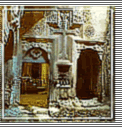
architecture, a particularly rich part of the Armenian heritage,
is widely recognized as a unique contribution to international architecture.
The tradition of architectural engineering has ancient origins on
the Armenian highlands. During the Urartian period of Armenian history (9th through 6th centuries B.C.), existing traditions were developed and perfected. The Urartians were noted for their high standards in city building (Ainili, Tushpa, Argishti, Erebuni,), palatial complexes and richness of interior decoration. Urban architectural traditions, as well as other forms of art in pre-Christian Armenia, were developed further under the influence of ancient Hellenistic and Roman art. The temple of Garni is the only pagan monument existent in Armenia. Armenia entered a new phase of architectural development with the adoption of Christianity as state religion in 301 A.C. City building and other forms of architecture entered a new and long-lasting developmental phase, while persevering older traditions. In
the early Christian period in Armenia (5th through 7th centuries),
church architecture proceeded with the creation of various basilical
domed houses. Armenian architecture carved its national style with
the construction of the cathedrals of Echmiadzin, Ererouk, Hripsime,
Zvartnots, and Geghard monastery. During the 9th through 14th centuries, Armenian architecture proceeded on the same developments path and crated new masterpieces: the monasteries of Amberd,Tatev, Aghtamar, Marmarashen, Sanahin, Haghpat (9th through 11 centuries), s, Haghartsin, Goshavank, Magaravank, Ohanavank, Harichavank and Noravank (12th through 14th centuries). A
unique manifestation of Armenian medieval national art is comprised
by the monuments called khachkars or cross stones which were used
widely in Armenia. There are found in Armenia prehistoric monoliths
which had ceremonial significance in the pagan religion. Following
the conversion to Christianity, the wooden cross-symbol of the new
faith was erected in the various shrines in Armenia. The earliest
attempts to replace the wooden cross with a stone cross date back
to the period between 4th and 7th centuries. The cross stones were
used for a variety of purposes: to mark military victory, to commemorate
events of historic significance, to dedicate the conclusion of the
construction of churches, fountains, bridges and other structures. Following
the Sovietization of Armenia in 1920, two architectural directions
competed for dominance: the national and the modern. This dual track
of architecture produced various phases of Armenian architecture,
even during the short Soviet period. In Armenia today one can easily
see the differences in style between the national; the Government
Buildings of Republic Square, the State Opera House, the Matenadaran,
the Genocide Monument, and the modern: the Youth Palace, the Sports
complex, the Airarat movie theater, and the Zvartnots Airport.
|
|
|||||||||||||||||||||||||||||||||||||||||||||||||||||||||||||||||||
| embassy | armenia | diaspora | business | |||||||||||||||||||||||||||||||||||||||||||||||||||||||||||||||||||||
| @ a glance | geography | religion | history |culture | economy | government | tourism | |||||||||||||||||||||||||||||||||||||||||||||||||||||||||||||||||||||