 |
|
|
|
|
|
|
|
 |
|
||||||
 |
 |
 |
 |
 |
 |
 |
|
|
government : declaration of independence : constitution The Republic of Armenia is a sovereign, democratic, social, rule of law state. The state power is administered pursuant to the Constitution and the laws based on the principle of separation of the legislative, executive and judicial branches. The Constitution of the Republic of Armenia adopted on July 5, 1995, through a popular referendum provided legal guarantees of civil rights, the development of democratic institutions, and the creation of a market economy to secure the future stability of the Armenian state. THE
PRESIDENT Armenia is a republic with a presidential governing system. The president is the head of state. According to Chapter 3, Article 49 of the Constitution of the Republic of Armenia, "The President of the Republic of Armenia shall uphold the Constitution, and ensure the normal functioning of the legislative, executive and judicial authorities. The President of the Republic shall be the guarantor of the independence, territorial integrity and security of the Republic." The same person cannot hold the office of president for more than two consecutive terms. The people directly elect the President for a five-year term. The President's primary responsibility is the formulation of policy, the conduct of foreign and defense policies, and ensuring the normal functioning of state institutions. The first president of the Republic of Armenia, Levon Ter-Petrossian, was elected on October 16, 1991. In 1998, he resigned. Then-Prime Minister Robert Kocharian became Acting President. Extraordinary elections were set for March 16, 1998. Because no candidate garnered 50% + 1 of the votes, the first round of elections required a run-off between the top two candidates from the 12 original candidates. Acting President Robert Kocharian was elected President of the Republic of Armenia on March 31, 1998. THE EXECUTIVE BRANCH Chapter 5, Article 85 of the Constitution of the Republic of Armenia states: "Executive
power in the Republic of Armenia shall be vested in the Government
of the Republic of Armenia. THE CABINET
THE LEGISLATIVE BRANCH Legislative
power in the Republic of Armenia belongs to the National Assembly
(Parliament), which implements its activities through sessions,
permanent and temporary committees, as well as through its deputies. According to Chapter 4, Article 62 of the Constitution of the Republic of Armenia, "Legislative
power in the Republic of Armenia shall be vested in the National
Assembly. On
May 25, 2003, the Republic of Armenia held its third scheduled parliamentary
elections since independence. Following the new constitutional requirements,
of the 131 deputies (or Members of Parliament) elected, 56 were
elected through the majoritarian electoral system and 75 deputies
were elected through the proportional representation system. The
proportional representation system provides for seats for political
parties and political blocs divided according to a proportional
system.
In conformity with Article 29 of the Rules of Procedure of the National Assembly, the members of Parliament who have been elected to the National Assembly by the proportional vote registered in party or election bloc lists, set up parliamentary factions irrespective the number of members of parliament.
THE JUDICIAL BRANCH In
the Republic of Armenia justice is carried out by Courts in accordance
with the Constitution and the Law. In the Republic of Armenia, the
courts of general competence are: courts of first instance, review
courts and the Court of Appeals. There are also economic, military
and other courts provided by the Law. The President of the Republic
serves as a guarantor of independence of judicial bodies. He is
the Head of the Council of Justice.
"...A
judge may hold office until the age of 65, while a member of the
Constitutional Court may hold office until the age of 70. They may
be removed from office only in accordance with the Constitution
and the laws." Armenia is the only former Soviet Republic represented at the Council of the International Association of Constitutional Law (IACL.) The Council, founded in 1983, boasts over 100 member countries. source: official website of the armenian foreign ministryofficial website of the president of the republic of armenia |
PRESIDENT
OF THE REPUBLIC OF ARMENIA
|
|||||||||||||||||||||||||||||||||||||||||||||||||||||||||||||||||||||||||||||||||||||||||||||||||||||||||||||||||||||


















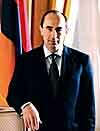 |
President
Robert Kocharian was elected to the office in April 1998, marking
the second presidential administration of the Republic of Armenia
in post Soviet-independence.
The Kocharian Administration is known for its visionary leadership
to integrate Armenia into regional and global economies with its
open-door policy for international investments, participation in
regional programs, and in its pursuit of a peaceful and lasting
resolution of the Nagorno-Karabagh conflict.
Robert Kocharian was born in 1954 in the capital of Nagorno-Karabagh,
Stepanakert. He graduated from the Yerevan State Polytechnic Institute
with an engineering degree. He married Bella Kocharian and they
have three children.
Robert Kocharian's leadership began as early as 1989, when he became
a key person in Nagorno-Karabagh's self-determination movement,
one of the founders of the Miatsum (Unification) non-governmental
organization, and an Adviser to the Chairman of the Executive Committee
of Nagorno-Karabagh. In 1989, he was elected deputy to the Supreme
Soviet (Parliament) of the Republic of Armenia as a representative
of Nagorno-Karabagh.
In 1992, Robert Kocharian was appointed Prime Minister of Nagorno-Karabagh,
while also heading the State Committee on Defense. Under military
attack by the Azerbaijani military, he organized the Nagorno-Karabagh
self-defense forces. Thanks to successive victories of the defense
forces, both the people and the borders of Nagorno-Karabagh were
once again safe and secure from Azerbaijani aggression. In May 1994,
a cease-fire between Nagorno-Karabagh and Azerbaijan was negotiated,
which still holds today.
Under Kocharian's leadership, Nagorno-Karabagh became a negotiating
member of the Organization for Security and Cooperation in Europe
for the settlement of the conflict. He also became the first Karabagh
representative to negotiate directly on behalf of the people of
Nagorno-Karabagh in international forums.
In 1994, by an overwhelming majority, Robert Kocharian was elected
the first President of Nagorno-Karabagh. Kocharian's appeal that
"a nation tested by the ordeal of war must pass the test of
peace," marked the beginning of a large-scale social and economic
rehabilitation of Nagorno-Karabagh.
In 1997, Armenia's First President, Levon Ter-Petrossian appointed
Robert Kocharian as Prime Minister of the Republic of Armenia. While
in office, he tackled issues of corruption and intensified efforts
to institutionalize a free-market economy. After President Levon
Ter-Petrossian's resignation, Robert Kocharian ran a charismatic
and populist campaign against leading presidential candidate Karen
Demirchian, and won the presidency in an open and fair election.
Sports, and particularly basketball, swimming and other water sports,
and winter sports figure prominently among Robert Kocharian's hobbies.
He also enjoys hunting. President Kocharian's favorite music is
jazz.
source: official
website of the president of the republic of armenia
RELATED LINKS |
|
President of Armenia Government of Armenia Parliament of Armenia Armenian Constitutional Court Central Bank of Armenia
|