|

|
history
:
timeline
ANCIENT
LAND AT GRIPS WITH ADVERSITY
 |
|
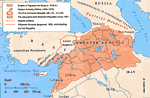
Historical
map of Armenia
|
- The
present-day Republic of Armenia occupies but a fraction of the
ancient Armenia, which extended from the lesser Caucasus Mountains
south across the Armenian plateau to the Taurus Mountains. Frequent
earthquakes still remind us that the land lies near the great
geological fault between the Asian and African subcontinent plates.
The Armenian plateau is a highland which rises directly above
its surrounding regions. Geography undoubtedly played a key role
in the history and culture of Armenia. Forming an important coin
of vantage and a highway of great value for trade and commerce
between Asia and Europe, Armenia it seems was destined to be at
grips with adversity. The land with its untold riches and its
strategic position of primary import, stirred the ambitions of
many "superpowers" of the region. For a succession of
centuries, the Armenians were in constant warfare with invaders
and conquerors - Assyrians, Romans, Byzantines, Parthians, Arabs
and Turks - who rolled over their homeland, although certainly
not without meeting the most stubborn resistance. Throughout these
turbulent centuries, the Armenians successfully asserted their
historical identity and upheld their national heritage against
great odds. Although on occasions overpowered by superior forces
and reduced to the status of vassals, they nevertheless enjoyed
a semblance of national autonomy. Yet, the very vicissitudes that
troubled its existence contributed to the creation of a varied
and original culture, held together by the constants of social.
intellectual and religious institutions.
ORIGINS
OF THE ARMENIAN NATION
- Armenian
tradition has preserved several legends concerning the origin
of the Armenian nation. The most important of these tells of Hayk,
the eponymous hero of the Armenians who called them- selves Hay
and their country Hayk' or Hayastan. The historian of the 5th
century, Movses Khorenatsi, also relates at some length the valiant
deeds of Aram whose fame extended far beyond the limits of his
country. Consequently, the neighboring nations called the people
Armens or Armenians. Archeology has extended the prehistory of
Armenia to the Acheulian age (500,000 years ago), when hunting
and gathering peoples crossed the lands in pursuit of migrating
herds. The first period of prosperity was enjoyed by inhabitants
of the Armenian upland in the third millennium B.C. These people
were among the first to forge bronze, invent the wheel, and cultivate
grapes. The first written records to mention the inhabitants of
Armenia come from hieroglyphs of the Hittite Kingdom, inscribed
from 1388 to 1347 B.C., in Asia Minor. The earliest inscription
to be found directly upon Armenian lands, carved in 1114 B.C.
by the Assyrians, describes a coalition of kings of the central
Armenian region referring to them as "the people of Nairi."
URARTU,
THE FIRST KINGDOM IN ARMENIA
 |
|
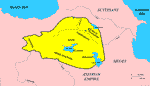
Urartu
(c. 750 B.C.)
|
- By
the 9th century B.C., a confederation of local tribes flourished
as the unified state of Urartu. It grew to become one of the strongest
kingdoms in the Near East and constituted a formidable rival to
Assyria for supremacy in the region. The Urartians produced and
exported wares of ceramic, stone and metal, building fortresses,
temples, palaces and other large public works. One of their irrigation
canals is still used today in Yerevan, Armenia's capital - a city
which stands upon the ancient Urartian fortress of Erebuni.
PERSIAN
RULE
- In
the 6th century Urartu fell to the Medes, but not long after,
the Persian conquest of the Medes, led by Cyrus the Great, displaced
them. Persia ruled over Armenia from the 6th century until the
4th century B.C. Its culture and Zoroastrian religion greatly
influenced the spiritual life of the Armenian people who absorbed
features of Zoroastrianism into their polytheistic and animistic
indigenous beliefs. As part of the Persian Empire, Armenia was
divided into provinces called satrapies, each with a local governing
satrap (viceroy) supervised by a Persian. The Armenians paid heavy
tribute to the Persians, who continually requisitioned silver,
rugs, horses and military supplies. The governing satraps of Armenia's
royal Orontid family governed the country for some 200 years,
while Asia became acquainted with invading Greeks from the west.
ARMENIA PARTITIONED
 |
|
Armenia
circa 250 B.C.
|
- With
the fall of the Persian Empire to Alexander the Great of Macedonia
in 331 B.C., the Greeks appointed a new satrap, an Orontid named
Mithranes, to govern Armenia. The Greek Empire, which stretched
across Asia and Europe, was one in which cities rapidly grew,
spreading Hellenistic architecture, reli-gion and philosophies.
Armenian culture absorbed Greek influences as well. As centers
at the crossroads of trade routes connecting China, India and
Central Asia with the Mediterranean, Armenian cities thrived on
economic exchange. The Greeks also infused Armenia's version of
Zoroastrianism with facets of their religious beliefs. After Alexander's
sudden death in 323 B.C., the partitioning of his empire and warring
among his generals led to the emergence of three Greek kingdoms.
Despite pressure from the Seleucid monarchy, one of the Greek
kingdoms, the Orontids, continued to retain control over the largest
of three kingdoms into which Armenia itself had been divided:
Greater Armenia, Lesser Armenia and Sophene.
THE
RENAISSANCE OF ARMENIA, TIGRAN THE GREAT
 |
|
Armenian
Empire (c. 80 B.C.)
|
- Seleucid
influence over Armenia finally dissolved when, in the second century
B.C., a local general named Artaxias (Artashes) declared himself
King of Greater Armenia and founded a new dynasty in 189 B.C.
Artaxias expanded his territory by defining the borders of his
land and unifying the Armenian people.
The "renaissance of Armenia" was accomplished during
the reign of Tigran the Great (95-99 B.C.), who proclaimed himself
"King of Kings." Under Tigran II, Armenia grew to a
great degree of military strength and political influence. According
to the Greek biographer Plutarch, the Roman general Lucullos said
of this king, "In Armenia, Tigran is seated surrounded with
that power which has wrested Asia from the Parthians, which carries
Greek colonies into Media, subdues Syria and Palestine and cuts
off the Seleucids." And Cicero, the Roman orator and politician,
adds, "He made the Republic of Rome tremble before the powers
of his arms." Armenia's borders extended from the Caspian
Sea to the Mediterranean.
THE
ARSACID DYNASTY
 |
|
Arsacid
Armenia (c. 150 A.D.)
|
- Tigran's
victories were, however, destined to hasten his downfall, which
occurred in 66 B.C. His son, King Artavazd II, governed Greater
Armenia for 20 years until Anthony and Cleopatra had him brought
to Egypt in chains. Artavazd refused to name Cleopatra as his
queen and was executed. By 64 A.D. the new Arsacid dynasty, a
branch of the Parthian Arsacids, came to power, and the country
as a whole soon became a buffer zone over which the Romans and
Parthians fought for domination. In order that we may realize
the real implications of the history of Armenia and grasp the
soul of this people, we must turn our gaze upon the beginning
of the 4th century, which was momentous in its consequences for
the growth of the nation.
THE
FIRST CHRISTIAN STATE IN THE WORLD
- One
of the most crucial events in Armenian history was the conversion
to Christianity. By adopting the new religion, Armenia established
a distict Christian character of its own and, at times, became
identified with the Western world. King Tiridates III (Trdat),
having been converted by Gregory the Illuminator, proclaimed Christianity
as the religion of the state in 301 A.D. Thus, Armenia became
the first nation to embrace Christianity officially. This was
12 years before the Emperor Constantine's Edict of Milan which
declared tolerance of Christians in the Roman Empire. Gregory
the Illuminator, later canonized, was elected Catholicos of the
new Armenian national Church, the first in a long line of such
clergy to he elected supreme head of the Armenian Church. The
creation of the Armenian alphabet in 405 A.D. solidified the unifying
factor of the Armenian language for the divided nation. Mesrop
Mashtots, a scholar and clergyman, shaped the thirty six (three
characters were added later) letters that distinguished Armenia,
linguistically and liturgically, from the poweres surrounding
it. The alphabet representing the many distinct consonants of
Armenian has remained unchanged for 1500 years.
BATTLE
FOR FAITH
- The
conversion to Christianity was inevitably to bring in its wake
complications of a political nature and to arouse grave anxieties
in neighboring Persia. The Sassanian Persians took advantage of
Armenia's inner weakness and launched a campaign to stamp out
Christianity there and replace it with Mazdaism. Under this common
threat, the princes, nobility and the people of Armenia rallied,
and in 451 under the leadership of the Commander-in-Chief (sparapet)
Vardan Mamikonian the Armenians heroically faced the Persians
at Avarayr in defense of their faith and national heritage. Heavily
outnumbered, they were defeated; Vardan Mamikonian and many valiant
men fell fighting. But guerrilla warfare continued in the mountainous
regions. Vahan Mamikonian, a nephew of Vardan, continued the struggle.
This time the Persians, realizing the futility of their policy,
were obliged to come to terms with the Armenians. Freedom of religious
worship was restored with the Treaty of Nvarsag.
THE
BAGRATID DYNASTY
 |
|
Medieval
Armenian Kingdoms
|
- In
the 7th century, the mighty Arabs stormed into Armenia and conquered
the country. Beginning in the 9th century, Armenia enjoyed a brilliant
period of independence when the powerful Bagratid Dynasty asserted
political authority. Resumption of international trade brought
prosperity and the revival of artistic and literary pursuits.
The capital of Ani grew to a population of about 100,000, more
than any urban center in Europe. Religious life flourished and
Ani became known as the "city of one thousand and one churches."
In the middle of the 11th century, most of Armenia had been annexed
by Byzantium.
THE
CILICIAN KINGDOM OF ARMENIA
 |
|
Cilician
Kingdom of Armenia
|
- The
destruction of the Bagratid Kingdom was completed by raids of
new invaders, the Seljuk Turks from Central Asia. With little
resistance from weakened Byzantium, the Seljuk Turks spread into
Asia Minor as well as the Armenian highlands. This invasion compelled
a large number of Armenians to move south, toward the Taurus Mountains
close to the Mediterranean Sea, where in 1080 they founded, under
the leadership of Ruben (Rubenid dynasty), the Kingdom of Cilicia
or Lesser Armenia. Close contacts with the Crusaders and with
Europe led to absorbing Western European ideas, including its
feudal class structure. Cilician Armenia became a country of barons,
knights and serfs. The court at Sis adopted European clothes.
Latin and French were used alongside Armenian. The Cilician period
is regarded as the Golden Age of Armenian Illumination, noted
for the lavishness of its decoration and the frequent influence
of contemporary western manuscript painting. Their location on
the Mediterranean coast soon involved Cilician Armenians in international
trade between the interior of Western Asia and Europe. For nearly
300 years, the Cilician Kingdom of Armenia prospered, but in 1375
it fell to the Mamelukes of Egypt. The last monarch, King Levon
VI, died at Calais, France in 1393, and his remains were laid
to rest at St. Denis (near Paris) among the kings of France.
PERSIAN
RULE IN EASTERN ARMENIA
 |
|
Armenia
in 1200
|
- While
in the 13th century the Armenians prospered in the Cilician Kingdom,
those living in Greater Armenia witnessed the invasion of the
Mongols. Later, in the 16th and 17th centuries, Armenia was divided
between the Ottoman Empire and Safavid Iran. With the annexation
of the Armenian plateau, the Armenians lost all vestiges of an
independent political life. The Persian leader Shah Abbas I inaugurated
a policy of moving populations of entire Armenian regions to his
country to create a no-man's land in the path of the Ottoman advance,
and to bring a skilled merchant and artisan class to his new capital,
Isfahan. The Armenian community of New Julfa, a suburb of Isfahan,
was held by Shah Abbas I in great esteem and became one of the
economic bases of the Safavid state. Persians ruled Eastern Armenia
until 1828, when it was annexed by Russia. However, it was the
Ottoman Turks who governed most of the Armenian land and population
(Western Armenia).
OTTOMAN
EMPIRE AND THE GENOCIDE
 |
|
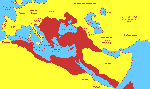
Armenia
in Ottoman Empire
|
- During
the 19th century, Armenians under Turkish rule suffered from discrimination,
heavy taxation and armed attacks. As Christians, Armenians lacked
legal recourse for injustices. They were taxed beyond their means,
forbidden to bear arms in a country where murdering a non-Muslim
often went unpunished, and were without the right to testify in
court on their own behalf. During the late l9th century, the increasingly
reactionary politics of the declining Ottoman Empire and the awakening
of the Armenians culminated in a series of Turkish massacres throughout
the Armenian provinces in 1894-96. Any illusion the Armenians
had cherished to the effect that the acquisition of power in 1908
by the Young Turks might bring better days was soon dispelled.
For in the spring of 1909, yet another orgy of bloodshed took
place in Adana, where 30,000 Armenians lost their lives after
a desperate resistance. World War I offered a good opportunity
for Turks to "solve the issue." In 1915, a secret military
directive ordered the arrest and prompt execution of Armenian
community leaders. Armenian males serving in the Ottoman army
were separated from the rest and slaughtered. The Istanbul government
decided to deport the entire Armenian population. Armenians in
towns and villages were marched into deserts of Syria, Mesopotamia
and Arabia. During the "relocation" many were flogged
to death, bayoneted, buried alive in pits, drowned in rivers,
beheaded, raped or abducted into harems. Many simply expired from
heat exhaustion and starvation. 1.5 million people perished in
this first genocide of the 20th century. Another wave of massacres
occurred in Baku (1918). Shushi (1920) and elsewhere.
THE
FIRST REPUBLIC AND THE SOVIET REGIME
- The
defeat of the Ottoman Turks in World War I and the disintegration
of the Russian Empire gave the Armenians a chance to declare their
independence. On May 28, 1918, the inde-pendent Republic of Armenia
was established, after the Armenians forced the Turkish troops
to withdraw in the battles of Sardarapat, Karakilisse and Bashabaran.
Overwhelming difficulties confronted the infant republic, but
amid these conditions the Armenians devoted all their energies
to the pressing task of reconstructing their country. But due
to pressure exerted simultaneously by the Turks and Communists,
the republic collapsed in 1920. Finally, the Soviet Red Army moved
into the territory (Eastern Armenia) and on November 29, 1920,
declared it a Soviet republic. Armenia was made part of the Transcaucasian
Soviet Federal Socialist Republic in 1922, and in 1936, it became
one of the Soviet Union's constituent republics. The tumultuous
changes occurring throughout the Soviet Union beginning in the
1980's inevitably had repercussions in Armenia.
INDEPENDENCE
 |
|
Armenia
today
|
- In
1988, a movement of support began in Armenia for the constitutional
struggle of Nagorno Karabagh Armenians to exercise their right
to self-determination. (This predominantly Armenian populated
autonomous region had been placed under the jurisdiction of Azerbaijan
by an arbitrary decision of Stalin in 1923.) That same year, in
1988, Armenia was rocked by severe earthquakes that killed thousands,
and supplies from both the Soviet Union and the West were blocked
by the Azerbaijani Government fighting the Armenians in Nagorno
Karabakh. Both of these issues have dominated Armenia's political
arena since the first democratic election held in Armenia during
the Soviet era. In 1990, the Armenian National Movement won a
majority of seats in the parliament and formed a government. On
September 21, 1991, the Armenian people overwhelmingly voted in
favor of independence in a national referendum, and an independent
Armenia came into being.
|