|

|
geography
: administrative
division :
maps
:
capital
The
capital of Armenia, Yerevan, is one of the world's oldest cities.
It was founded in 783 BC, several years before the founding of ancient
Rome, by king Argishti the First as Erebuni, the military and administrative
center of the state of Urartu. The ruins of the fortress Erebuni
are in the southeastern part of the present day Yerevan. The cuneiform
inscription found at the site of Arin-Berd reads: "With the
power of (God) Khaldi, I, Argishti, Son of Menua, erected this stronghold,
and named it Erebuni to the glory of the country of Biaina and to
the fear of its enemies.... "
It became part of an Armenian kingdom by the 6th century BC.
The city is located on the Razdan River only 14 miles (23 kilometers)
from the Turkish border.Erebuni-Yerevan has always played a significant
role in the economic, political and social life of Armenia. It was
one of the prominent commercial centers and was located across many
ancient trade routes. The invasions of Arabs and Seljuk Turks in
the VII-XI cc. seriously damaged the city and hindered its further
development.
In XV-XIII centuries Yerevan greatly suffered from Ottoman and Persian
invasions. After Eastern Armenia became part of Russia in
1828, Yerevan developed into the center of the Yerevan province.
The city kept on growing and on the turn of the century it occupied
a territory of some 102 sq. km with a population of 30.000 people.
Under
Soviet regime Yerevan became a thriving industrial city noted especially
for its petrochemical industry. The city also produces aluminum,
automobiles, turbines, compressors, electrical machinery, and machine
tools. Yerevan is a repository of ancient Armenian culture. The
Matenadaran Archives contain thousands of priceless ancient manuscripts.
The city has an academy of sciences, several research institutions,
and a university.
Since early Soviet era the city was developed according to
the prominent Armenian architect Alexander Tamanian's design. He
successfully incorporated both national traditions and world urban
construction elements. The design presented a radial-circular arrangement,
most appropriate for the local relief.
Yerevan is situated in the north-eastern part of the Ararat
Valley. Mounts Aragats, Azhdaak, and Ararat can be seen from the
city. With its rugged terrain, Yerevan displays a 400m disparity
between its lowest and highest points. The city is divided by Hrazdan
River that flows in a picturesque canyon.
The climate in Yerevan is dry and sharply varied with temperatures
in summer peaking over 35 C and falling below -15 C in winter.
|
 |
|
Fortress
of Erebuni overlooking present-day Yerevan
|
 |
|
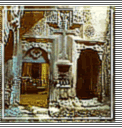
Matenadaran,
the National Depository of Ancient manuscripts
|
 |
|
Yerevan
Opera House
|
 |
|
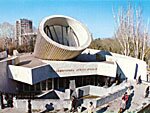
A
metro station in Yerevan
|
|