 |
|
|
|
|
|
|
 |
|
|||||
 |
 |
 |
 |
 |
 |
|
|
|
|
 |
|
|
 |
 |
|
 |
|
|
 |
|
|
 |
|
|
 |
|
|
 |
|
|

| armenian diaspora | eastern europe | western europe | middle east | south asia & australia | south america | north america |
Armenians in Eastern Europe
The large Armenian communities of Eastern Europe no longer exist. In Poland, the last Armenian Catholic archbishop died in 1938 and most of the remaining Armenians were killed during the Second World War. Lvov, now part of Ukraine, still maintains an active Armenian community centered around its fourteenth-century church. The world wars and the communist regime virtually ended Armenian presence in Hungary. The Armenians of Romania and Bulgaria, received many refugees from the political upheavals in neighboring Russia and Turkey in the years 1915-1922. Following the Second World War Communism closed most of the private enterprises owned by these Armenians. Many Romanian Armenians left for Europe and the United States, while large numbers of Bulgarian Armenians repatriated to Soviet Armenia. In the 1960s, they, too, began to leave for Europe and the United States. Some 5000 Armenians remain in Romania and are concentrated in Bucharest, Constantza, and Tulca. The 10,000 Bulgarian Armenians live primarily in Sofia and Plovdiv. Both communities maintain Armenian centers and churches.
 |
 |
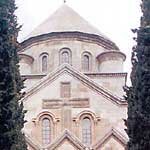 |
| Armenian church in Budapest, Hungary | Armenian church being constructed in Riga, Latvia | Armenian church in Yalta, Ukraine |
The Armenian Community of Cyprus is also the product of refugees who arrived
during the 1895-1922 years. In 1926 the Melkonian Educational Institute
was founded to educate and shelter the orphans of the genocide. During
the Lebanese civil war, the Melkonian had many students from that war-tom
country. Today a large number of its students are Bulgarian Armenians.
The 1974 Turkish invasion of Cyprus seriously affected the Armenian community,
for most of the Armenian quarter of Nicosia, with its clubs, school, and
church, fell into the Turkish-occupied sector. The same was unfortunately
true of Famagusta, whose Armenian church and monastery of Surb Makar have
been left in ruins and converted to a store. The Cyprus community, which
had over 15,000 members before the invasion, has been reduced to only
2,000, with the rest emigrating to the West. Prior to 1895 there were
only some 500 Armenians in all of Greece. About 150,000 Armenians arrived
after the massacres and the genocide, especially following the expulsions
of the Christians from Smyrna in 1922. After the Second World War, thousands
left for Armenia, North America, Australia, and Europe. A number of churches,
including an Armenian Evangelical church, serve the 10,000 Armenians in
Greece, most of whom live in Athens.
Source:
A History of the Armenian People by George A. Bournoutian
Images: AGBU magazine