 |
|
|
|
|
|
|
 |
|
|||||
 |
 |
 |
 |
 |
 |
|
|
|
|
 |
|
|
 |
 |
|
 |
|
|
 |
|
|
 |
|
|
 |
|
|
 |
|
|

Armenians in South America
The
Armenian community in South America, like that of Australia, arose in
the early twentieth century, as a result of immigrants who had survived
the genocide. Although they settled in various parts of the continent,
the majority went to Argentina, Brazil, and Uruguay, with some moving
to Venezuela and Mexico. Unlike their compatriots who had emigrated to
Europe or other parts of Asia, Armenians in the Americas had no previous
connections, commercial or cultural, to aid them in acclimatizing to such
a different culture. But, by the 1940s each of these countries had Armenian
teachers, engineers, doctors, and lawyers. In addition, Armenian craftsmen
opened their own businesses and, thanks to the economic boom in the region,
became affluent. Their economic successes prompted other Armenians to
relocate there from Greece and the Middle East and by the end of the 1980s
there were some 70,000 Armenians in Argentina, 20,000 in Brazil, and 15,000
in Uruguay, concentrated in Buenos Aires, Sao Paulo, Rio de Janeiro, and
Montevideo respectively. The numbers are somewhat deceiving, however,
for with the exception of the Argentine Armenians, the Armenians of South
America are not a cohesive community. A dozen churches (including Catholic
and Evangelical), a number of schools, newspapers, and clubs and AGBU
chapters have been established, but assimilation is taking its toll and
hyper-inflation, as well as political instability, have resulted in emigration
to North America.
 |
 |
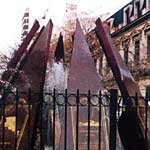
| Ararat Square in Buenos Aires with the new Genocide monument | St. Gregory the Illuminator Cathedral on Armenia Street in Buenos Aires |
Source:
A History of the Armenian People by George A. Bournoutian
Images: AGBU magazine